
4 Essential Habits for Freelance Graphic Designers

Incremental change is a powerful force. Recently, we explored how to stay focused as a freelance graphic designer (follow the link if you missed our piece!).
In today’s article, we’ve expanded the theme to help you find out how to leverage the power of incremental change to take your freelance graphic design business to the next level.
Do you feel like only boring people intentionally focus on their habits? We hear you, but we also know from experience that incrementalism works!
Creating effective habits doesn’t sound very appealing and sometimes seems impossible even…but small areas of focus, repeated often, produce outsized change! Let’s take a closer look, and we’ll change the course of your freelance design career for the better.
Habits are powerful forces distributed through unassuming and small packets of time. The truth is, you have 144 time packets of 10 minutes each…every day!
We know from our own experience that if you give one of those 144 time packets to each of the four essential habits we’re going to talk about today, you’ll have meaningful, productive, and seemingly effortless increases towards accomplishing your freelance goals.
Think of habits like a game: the more you perfect the moves in this game, the better your end score will be. It would be silly to play a video game and think of individual moves and little decisions as “boring” or “worthless”…they’re essential if you want to win, after all!
When you combine the incremental force of every little move and habit you focus on, you become a powerhouse of results.
In Order to Focus, Know Your Goals
If you’ve heard it once, you’ve heard it a thousand times: the C-suite executive who credits their professional success on having a solid core of habits and behaviors.
Trouble is, every CEO and professional titan will name a different habit, a different goal, and a different way they incorporate it in their day. That’s because we’re all different, right? Makes sense.
But how can those valuable hints translate to our own life? Even if we wanted to replicate their suggestions exactly, we have a different life, a different job, and different parameters to work with! There’s only one place to start:
#1 Prioritize
Prioritizing means to put your focus on some things more than others. Simple, right?
Practically speaking, you prioritize by picking your battles. In the context of building a freelance graphic design business, we know that there are core themes to focus on (follow that hyperlink to our blog post on how much freelancers can earn, if you need some inspiration for your core goals).
If you analyze those inspiring CEO podcast interviews, their core habits for success can be whittled down to a few more common themes:
#2 Planning Your Schedule
#3 Maintaining a Calendar
#4 Knowing Today’s Plan
If you give a little bit of attention to these items every day, you will infuse your freelance graphic design career with the keys to incremental success. You may not be that podcast CEO yet, but you will be actively growing in that direction!
At the start, you need to prioritize the areas of your business that need your attention (urgent matters versus longer-term goals). Then, you can execute the appropriate daily actions to sign clients in your freelance business. Easy-peasy. Really.
So, let’s focus on how to prioritize. Take 10-minutes and a piece of blank paper, and write down the answers to these questions:
- What is the mission statement for my freelance business?
- Why did I want to be a freelancer in the first place?
- What do I want to be doing one year from now (income, hours working per week, employees working for me, etc.)?
- What is my long-term plan for my business (growth in number of clients, growth in expertise, growth in annual revenues, or maybe something completely different…like early retirement, sale of the business, or philanthropy)?
Congratulations, you have just prioritized successfully. And it only took one little 10-minute time packet!
To make the key points jump out, take a pen and circle the key phrases on your page. Highlight five words or phrases that you wrote. Only the most significant ones — don’t overthink it, just go with your gut.
Those are your core priorities. Now that you have them written down, keep this paper (or save a screenshot). Looking back on it later will make re-prioritization easier.
Now that you know what your core priorities are, how can you achieve them? Let’s break down habit forming more so your can move forward with freelance CEO success habits #2, #3 & #4.
A Quick Math Note:
You have 144 ten-minute time packets in a day, but we know you sleep and eat and go down Instagram rabbit holes with lots of them.
Let’s say you successfully carve one 10-minute packet per day for an effective new habit — that adds up to 60 hours a year! Now we’re talking about traction time, where what you do daily builds up incrementally to make a big difference.

Planning Your Schedule
You have your priorities written down (really, they’re your goals, mission, vision, purpose — all in one short list of 5 circled words or phrases!). Next, we’re going to figure out how to take abstract ideas and turn them into accomplished goals.
As a freelance brand, web, or graphic designer, your schedule is critical. Notice that all of your effective habits involve how you use your time. It isn’t an accident that we are going to focus our attention on the one thing we can’t make more of — time.
Planning your schedule can be simple. For the next couple of days, take a few minutes to develop a list of the main ways you need to spend your time that day. This is the key, because oftentimes designers try to work on too many things in a day… and then none of them get finished.
Think about this wisely and practically, and remember that practical time management includes rest. (There are many studies that show you will produce more if you sleep more ….think on that reality and plan accordingly!)
Your basic schedule will likely have the following parameters, but feel free to change this for your unique circumstances and be creative.
Do you need to plan around your children’s school schedule, or your partner’s work rotations, or your annual week of detoxing from your phone? Go ahead and make those notes too so you know what you need to plan for.
- Work days – How many days do you want to work per week? How long is each day? Where will you work? How many weeks this year will you vacation? What time will your day generally start? What time will your day end, most days? What will your professional development goals require, time-wise?
- Days off – How many per week? Which days? Can you work at all on these days, or is it a hard line? Are there professional development activities you should schedule for your days off (ie. therapy sessions, reading, online classes, tangent hobby development, casual social media network development)?
After you’ve spent some time thinking about your “Work days” and “Days off,” it’s time to sketch out your typical schedule. Your new schedule will become the schedule you try to follow daily.

Now, since one of the major benefits of freelancing is that you have more freedom, it’s okay if every day’s schedule is different. Sometimes you may work in the morning, sometimes at night, sometimes from a library, sometimes at a beach…
So even if your schedule isn’t exactly consistent, that’s okay. Just think about the week ahead and what makes sense for those upcoming 7 days.
To plan your schedule, you could write out a small note with the typical schedule (basic start and end times each day and what you’ll be focused on each day, ie. work/leisure) and tape it to your mirror.
After you brush your teeth each morning, use a pen you’ve stowed in the medicine cabinet to note today’s date and put a check mark beside it. Read your typical schedule note out loud to yourself (ie. Monday I work at my laptop from 8am to 12pm).
This will cement the habit, encourage daily compliance, and take less than 30 seconds to accomplish! (Visual cues can be very useful reminders when developing new habits.)
Maintaining a Calendar
Our next habit to develop is maintaining a calendar. This is more granular than the time planning exercise of the last habit. Now that you know where you will be every day (and during which hours, approximately), you can figure out what to do.
It might help to reframe the importance of a calendar. A bank account tracks your money, right? You can go online and check it and, without it, your money would be a loose pile of cash flowing through your hands without any documentation or organization….a total mess, right?!
Your calendar is like a bank account for your time. It’s not an option, it’s a necessity. (Unless you want your time to flow through in a blurred mess, like your money would if it was just lying around your house!)
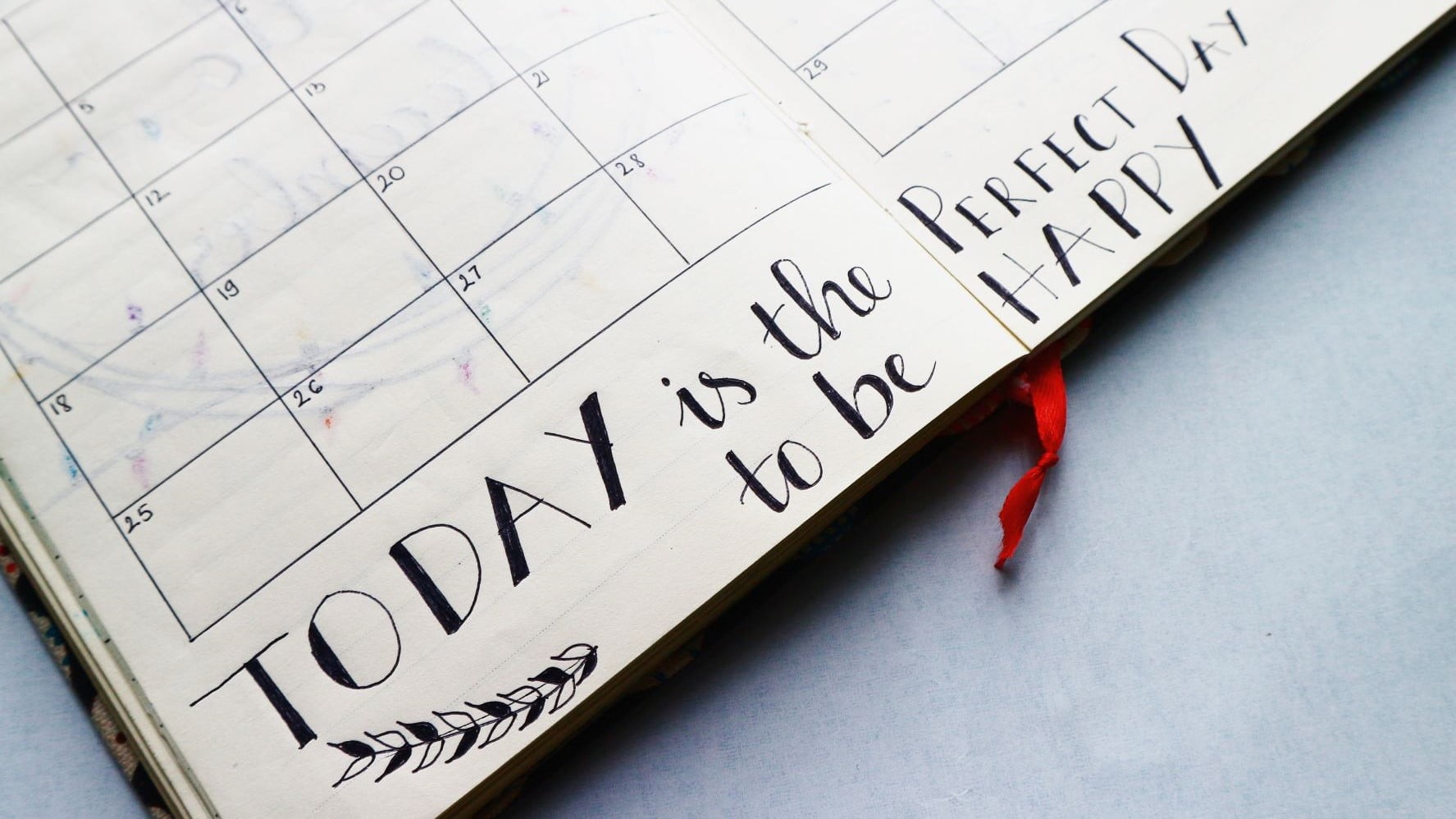
And even though one of the benefits of being a freelance graphic designer is the ability to set your own schedule, you will still be more effective if you keep a calendar. You might use Google Calendar, or maybe another app you’ve found. You can also use a paper-based book-style calendar if that’s what floats your boat.
The key is to write everything down in one central (digital or paper) place. Every calendar app or diary will have the days of the year showing in an organized way, as well as the individual hours of the day.

This level of calendar organization is essential — you don’t want to use a note taped to your bathroom mirror for this habit! You need a quality calendar.
Focus on your calendar with gusto. Plan it, and as soon as you’re ‘at work’ according to your taped-on-the-mirror-schedule’s plan, spend the first 10 minutes of every day looking over your calendar.
What’s coming up this week? What did you forget to jot down yesterday? What personal appointments need to be fit in? When do you want to send cupcakes to your child’s class next, or take a yoga class in the middle of the week?
Note these things on the calendar! Slot them in. Decide ahead of time when you will do these things. (And, we have a big spoiler for you….you are much more likely to successfully complete each action simply because you planned ahead, wrote it down, and looked at your calendar every day!)
A Quick Vision Casting Note:
As you succeed, you get busier. In fact, figuring out what projects and commitments to say no to is a real issue you’ll need to think about as your freelance graphic design business grows!
You’re more likely to drown from success than from lack of it, as counter intuitive as this fact is. This article is all about the reality that habits work….and they lead to success. Get ready to be busier!

Starting Each Day with a Focus List
This last habit we’re going to encourage you to develop can be done while you’re already reviewing your calendar.
But, we’d encourage you to see it as a separate — and immensely valuable — activity in its own right. No matter how you incorporate it into your schedule, we know your success trajectory will be solidified through this last, simple, daily habit.
On your desk, your laptop or your phone, have a daily Focus List. (It’s a To Do List with name upgrade 😊.)
Can you see how this list would be easy to create immediate after your first-thing-in-your-work-day calendar review? You could also implement this habit during the last 10 minutes before you wind up and shut down the laptop at the end of your work-day.
We recommend keeping your daily list focused on three daily actions. If you say that today you are going to connect with potential graphic design clients on LinkedIn, work on a client’s logo, redo your proposals, make your Instagram strategy, and improve your portfolio… that isn’t realistic.
You will burn out – or worse, spend a few minutes on each task and never finish any of them.

Instead, maybe today you will work on a logo, connect with 5 potential clients on LinkedIn, and start working on your Instagram strategy. Three things – that’s it!
Then maybe next week when you are done with the Instagram strategy, you will work on adding 1 new passion project to your portfolio – but for now, the portfolio can go on hold. Do you see how that three-daily-actions approach sounds much more manageable?
Be creative and find what works for you. Maybe keeping a small notebook on your bedside table with a tear-off sheet for a daily Focus List would help, or you can maintain a Google document where you set your three daily actions. The more consistently you make a daily Focus List, the more likely it will be to help you.
Over time, you will find that your Focus List will help you bring all the scattered bits of your day and move them towards your calendar where they can be scheduled for completion.
Enjoying the Power of Incremental Habit Building
Successful freelancers know that habits create success. Simple efforts, produced daily, add up to graphic design business success.
Habit building and the results that come from them are an exponential source of power. There’s a reason that so many podcasts ask successful people about their daily habits.
And there’s a reason why it’s so easy for executives, celebrities, and leaders to quickly describe what they do!
Habits are the building blocks of professional (and personal) success, and we hope you start implementing your schedule and daily Focus List to stay focused as a graphic designer.
For more strategies to build strong habits, develop a freelance mindset, and get more graphic design clients, be sure to check out our Money-Making Freelance Bundle!